
Youth competitions build the foundation for the long-term survival and long-term development of professional football. The world of sports has become more complicated than before. This means that a young player moving from a local academy to the big top level needs regular well-organized experiences in tough tournaments. The time when you could just depend on talent is gone. Now planned development decides success. Youth competitions also attract interest from sports analysts and international football audiences. Sports entertainment platforms such as Melbet illustrate the broader connection between football information and digital betting markets. However, professional scouting relies on dedicated performance analysis, direct observation, and club recruitment networks rather than betting platforms. It helps teams make possible plans for growing their players.
The Institutional Role of Academies And Tournaments
Academy training and individual drills cannot fully prepare young athletes for the demands of professional football. Competitive youth leagues allow coaches to assess how well players apply their skills in unpredictable match situations.
Organized youth leagues are created to copy the pressures of adult football in a safe and growing environment. If players don't have organized matches against different teams their body development and understanding of the game will stop improving. These matches are a step helping young players slowly get used to the hard things in adult football. When they take part in seasons young players learn how to deal with people watching them adjust to how referees make calls, deal with loud away crowds and really be responsible for the choices they make during the game.
Physiological And Tactical Adaptation
Integrating academy prospects into a first-team squad is a major physiological and psychological transition. The gap between under‑16s and senior professionals in growth, game speed and tactical complexity is huge. Because of that, competitive tournaments at the U‑17 U‑19 and U‑21 levels are very important. These competitive tournaments act as a testing ground where academy prospects can improve both psychological skills at the same time helping to reduce the developmental leap, between academy prospects and senior professionals.
Several core athletic and cognitive competencies can only be developed through authentic, high-intensity match experience:
Tactical Flexibility and Spatial Awareness. Youth competitions teach players to adjust their positioning and respond to different tactical systems. For example, a team may switch from a 4-3-3 formation to a 3-5-2 depending on its approach to possession, pressing, and defensive organization.
Physical Conditioning and Match Intensity. Competitive matches help young players adapt to pressing, physical challenges, and repeated high-intensity movements. These experiences support the development of endurance, strength, and physical resilience.
Professional Periodization Regimens. Professional Periodization Regimens keep a rhythm for the whole season mixing hard training, long trips across the country, games and the rest needed after each match. That steady rhythm stops a player from getting burnt out too soon.
Decision‑Making Velocity under Pressure. Decision‑Making Velocity under Pressure speeds up how fast the mind works. In games Decision‑Making Velocity under Pressure gives very little room for mistakes and only a brief moment with the ball. Youth tournaments mimic that thinking, making players pay for standing still and giving big rewards, for guessing ahead.
Without them, it feels impossible for youth competitors to develop true football skills.
Psychological Resilience and Dual-Career Pathways
Youth competitions go beyond the physical game and tactical training. They are where young players build strength. The path of a footballer is not straight. It is full of ups and downs. In tournaments players often face moments – missing penalties, making big mistakes in defense, getting injured or losing back-to-back games. These experiences can hurt confidence.. When they happen in a safe supportive academy environment the emotional damage is less likely to last. Coaches use tournament situations to teach how to control emotions, stay focused and lead when things go wrong.
Also top youth competitions are placing value on dual-career paths. They know that a few players will make it to professional contracts with big paychecks. So clubs are using tournaments to help players develop skills that help them in life, not football. The discipline needed to prepare for a youth tournament is similar to what is needed in college or in a job. By creating a supportive environment clubs make sure players are ready not only for the game but also for life, after football.
Economic Multiplier And Transfer Policy
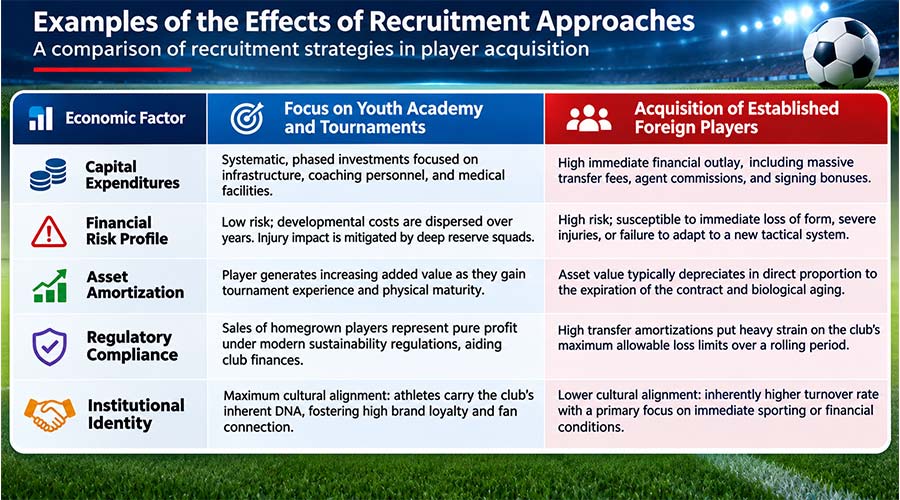
Youth development can contribute to a football club's financial stability by reducing reliance on expensive transfers and creating opportunities to develop valuable players. Financial regulations also influence how clubs manage these investments. UEFA's financial sustainability rules allow certain youth development expenses to be treated as deductions in the calculation of football earnings. In the Premier League, the Squad Cost Ratio (SCR) and Sustainability and Systemic Resilience (SSR) rules replaced the previous Profitability and Sustainability Rules (PSR) from the 2026/27 season. These frameworks make long-term financial planning important, although academy investments do not guarantee a higher financial return than external recruitment.
When a club focuses on developing talent from within it changes the way money flows. It cuts down on wage costs, avoids high agent fees and opens up a steady stream of income when players are sold later. The sale of a player who came through the academy counts as profit, under today's accounting standards. This makes it much easier for clubs to manage their finances or put money back into parts of the team.
The different effects of recruitment approaches are shown in the table:
Digitization Of Scouting And Telemetry Collection
The way talent is identified in youth leagues has changed significantly over the past decade. Traditional scouting, based on live observation and written reports, is now increasingly supported by digital tools. Video analysis, tracking systems, and performance databases allow scouts to assess players more systematically. These tools include devices that monitor player movement, cameras that automatically capture tactical patterns, and software that analyses data to identify trends.
Coaching staff and remote analysts now have access to detailed metrics. They track the sprint speeds maps showing where players are most active, how well passes are completed when under pressure and the chance of scoring (xG) for players as young as fifteen. As this large amount of data becomes easier to get for everyone, professional analysts depend a lot on digital networks to follow how young players grow and develop around the world.
Digital platforms also allow international football audiences to follow selected youth competitions, results, and emerging players. Sports entertainment services, including the Melbet mobile app (Turkish: Melbet mobil indir), illustrate how mobile technology connects football information with betting markets in jurisdictions where gambling is permitted. However, professional scouting requires specialized tools and access to verified performance data. This new kind of connection makes things fairer, letting scouts from smaller teams back up what they see on the field with real clear data without needing a big money budget for travel.
Globalization Of International Championships
At the top of this development pyramid are FIFA and UEFA youth competitions, like the U-17 and U-20 World Cups and also regional ones such as the UEFA Youth League. These big international events are the places to find new global talent. They set the standard for how players should develop by bringing together very different styles of playing football.
In these tournaments young players get to see ways of playing football that don't happen very often in regular local leagues. A Spanish player who is very good with the ball might have to deal with the fast play of an African team. At the time an Italian team that plays very defensively has to deal with the unpredictable and creative style of South American players. This experience is very important for learning. It makes players change the way they play to deal with different problems during the game.
A nation’s performance at youth events gives a strong signal about how healthy its football federation really is. When young players do well on the stage it shows that the country has made smart long-term investments in grassroots football. This includes building academies and creating strong youth leagues. These efforts don’t just help individual players grow, they also lead to results for the senior national team years later.
They bring together coaches from countries creating opportunities for real professional connections. Coaches get to see styles of play and training methods. When they return home they bring back ideas that change how they train their own teams. This sharing of knowledge helps improve football programs and raises the quality of the sport, around the world.